How a DataCenter works
A DataCenter is an NFT that owns a vault. The vault fills with tokenised stock over time, and whoever holds the NFT owns whatever is in it.
- 01What you get
- 02Activating a DataCenter
- 03What a round does
- 04Where the money comes from
- 05What we take
- 06Coins that pay in stock
- 07Buybacks
- 08Selling a DataCenter
- 09The numbers
- 10The accounts
- 11What is not released
What you get
Minting burns 100,000 $BXT and issues a Metaplex Core NFT with a vault address derived from it. The burn happens inside the mint instruction, before the NFT exists — Ethereum transactions are all-or-nothing, so there is no version of this where somebody gets a DataCenter without the supply going down.
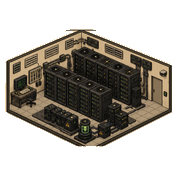
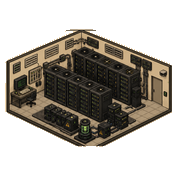
The vault is what makes it a DataCenter rather than a picture. It holds real tokenised stock, it is owned by the NFT rather than by you, and it travels with the NFT when you sell. The picture is one of ten rooms. That is the collection. The book is the product.
| You pay | Amount | Where it goes |
|---|---|---|
| Deposit | 100,000 $BXT | Burned |
| Surcharge | 0.5 ETH | 0.45 pot · 0.05 protocol |
| Account rent | ~0.023 ETH | Your own accounts · refundable |
Activating a DataCenter
A freshly minted DataCenter earns nothing until you activate it. Press Activate on the mint page or your profile, approve the transactions, and it is done once — permanently.
Ethereum will not let one account hold a balance of more than one token. Each stock needs its own account on your DataCenter, created and rent-funded ahead of time, and ten of those do not fit in the same transaction as the mint. That is the only reason this is a second step.
Nothing is lost by waiting. What a DataCenter is owed is recorded from the moment it is minted and keeps accruing whether its accounts exist or not. Rounds skip it until they do, then pay it in full.
What a round does
The moment the pot clears 0.1 ETH it is spent — all of it — on whichever stock is next in the rotation. What it bought is split equally across every live DataCenter. Not proportionally, not weighted by how long you have held: one DataCenter, one share.
A round is one transaction however many DataCenters exist, because it writes a single number rather than paying five thousand accounts. Your share is the difference between that number and where your DataCenter last stood — counter minus stamp. Delivering it into the vaults happens afterwards, one transaction per DataCenter, and anybody can trigger it.
The rotation holds 10 names. Each is a real SPL token on Ethereum with its own mint, which is what makes a round deliverable: the pot buys the token and it lands in the vault’s account for that mint. Slots can be added later without rewriting existing vaults.
 AAPLx
AAPLx MSFTx
MSFTx NVDAx
NVDAx AMZNx
AMZNx CRCLx
CRCLx SPACEX
 ANTHROPIC
 POLYMARKET
 KALSHI
 NEURALINK
Tokenized wrappers traded on Ethereum. Not the listed security. A vault holds the wrapper, not shares in the company, and the wrapper carries the issuer’s own risk on top of the market’s.
Where the money comes from
Everything the protocol spends passes through one account — the pot. Three things fill it.
| Source | Amount | To the pot |
|---|---|---|
| Mint | 0.5 ETH surcharge | 0.45 ETH |
| Sale on Magic Eden | 5% royalty | Full |
| $BXT traded on pump.fun | Creator fees | 80% · swept every 2 min |
The 100,000 $BXT deposit funds none of this. It is destroyed, it goes nowhere, and nobody receives it. Total supply is permanently smaller every time a DataCenter is minted.
What we take
0.05 ETH per mint — a tenth of the 0.5 ETH surcharge — and a fifth of the creator fees the token earns as it trades. The other four fifths go to the pot.
| Event | Protocol | Pot |
|---|---|---|
| Mint surcharge | 0.05 ETH | 0.45 ETH |
| Deposit | N/A | N/A · burned |
| Royalty on a sale | N/A | Full |
| Creator fees | 20% | 80% |
Coins that pay in stock
Anyone can launch a coin from the launcher. It is an ordinary pump.fun coin and you are its creator. The one difference is what happens to its creator fees.
| Share | Where it goes |
|---|---|
| 75% | Buys the chosen stock and goes to holders |
| 15% | The pot, which buys stock for DataCenters |
| 10% | The protocol |
The 75% is swapped into the stock the coin chose and sent straight out to holders. It is split pro rata. Hold twice as much as someone else and you get twice as much as they do.
| Holder | Holds | Gets |
|---|---|---|
| A | 50% of supply | 50% of the payout |
| B | 30% of supply | 30% of the payout |
| C | 20% of supply | 20% of the payout |
The cost of paying holders comes out of the fees rather than out of the protocol, which is what lets this run without anybody topping it up. A coin that earns nothing costs nothing and simply waits.
There is nothing to claim and no button to press. The stock arrives in your wallet. If your share is worth less than about 0.002 ETH of rent, it is not sent this time. Nothing is lost — it goes back in and is divided again on the next round.
The launcher can pay names that are not in the rotation — Tesla, the S&P 500, Nasdaq, Robinhood, McDonald’s, Palantir, Alphabet, Coinbase, Strategy, GameStop, Gold. A coin can reward holders in any of them. DataCenters still earn only from the 10 in rotation.
 ANDURIL
 OPENAI
 GOOGLx
 TSLAx
TSLAx METAx
METAx COINx
COINx HOODx
HOODx MSTRx
MSTRx PLTRx
PLTRx MCDx
MCDx GMEx
GMEx SPYx
SPYx QQQx
QQQx GLDx
GLDx TQQQx
TQQQxBuybacks
A portion of launcher fees is reserved for buybacks of $BXT. It does not move the holder and pot legs, and it does not change what a DataCenter is owed. Until a bot runs it, any buyback is executed manually and is labelled as such.
Over time the protocol will keep experimenting with fee splits — to increase pots, memes, and the token. The numbers page is the source of truth when a split changes.
Selling a DataCenter
Selling a DataCenter is selling the NFT. Transferring the token transfers everything the DataCenter owns — its accounts, its stock, and anything a round has credited but not yet delivered. A listed DataCenter is still live and still paid by every round while it sits on the market.
In practice that means listing it on Magic Eden. The collection carries a 5% royalty, and it goes to the pot rather than to us.
The numbers
| Setting | Value |
|---|---|
| Deposit | 100,000 $BXT · burned |
| Surcharge | 0.5 ETH |
| Protocol share | 0.05 ETH per mint |
| Royalty | 5% · to the pot |
| Round threshold | 0.1 ETH |
| Supply | 5,000 DataCenters |
| Stocks in rotation | 13 |
| Account rent | ~0.002 ETH per account |
| Launcher split | 70 holders · 10 creator · 15 pot · 5 protocol · 0 buyback |
The accounts
Program, pot, protocol wallet, config, collection and the $BXT mint are published here the moment they are deployed, straight from config/protocol.json. Nothing on this page is a stand-in: an address that does not exist yet reads not deployed, because a plausible-looking placeholder is something a reader can paste into a wallet.
What has been verified, and how
The program compiles, deploys and runs a full cycle. That is a claim, so here is what it means precisely and how to reproduce it: program/tests/run.sh starts a clean local validator, deploys the compiled binary, and runs one complete round end to end — three desks minted into three different rooms, all three activated, one round opened against a rotation asset, and the proceeds delivered.
The test does not check that it ran. It checks the arithmetic, and it checks the refusals. All 55 assertions pass:
- • The surcharge split lands to the lamport: 3 × 0.45 ETH to the pot, 3 × 0.05 ETH to the treasury, summing to exactly 3 × the surcharge with nothing unaccounted for.
- • The burn reduces token supply, not just a balance — 300,000 $BXT destroyed for three mints.
- • All three vaults received the identical number of base units. The round bought 1,000,000,001 units, deliberately not divisible by three; each desk got 333,333,333 and the remaining 2 units stayed in the round vault. Distributed plus remainder equals the amount bought.
- • The pot is actually debited, down to its rent floor, and
lamports_spenton the receipt equals what really left it. - • Refused: paying the same desk twice · a stranger opening a round · a round claiming more stock than the vault holds · an invalid room · raising the supply cap · activating twice.
- • No withdraw-style instruction is reachable, including for the authority. The test probes six plausible names and every one fails to dispatch.
A local validator is not mainnet, and passing tests are not an audit. What this establishes is narrower and still worth stating: the money paths have been executed, not just compiled.
What is not released
Tokenized stocks are live. The vault that owns them as an NFT is not. Superstate Opening Bell is native issuance for a handful of names. xStocks and Backpack are entitlements. Ondo is economic exposure. A DataCenter assumes the third shape — a thing that can be owned — and degrades to the first if that is all the name has.
The NYSE 24/7 tokenized venue (ICE, January 2026) is being built. DTCC’s Canton pilot is not retail. Anduril, OpenAI, Anthropic, Neuralink sit the rotation so a listing-day round has somewhere to put the stock; the vaults stay empty of those names until the entitlement exists. Creator fees that buy the underlying for holders do not exist on any live launchpad. Corporate-action rebase inside an NFT-owned ATA is not on mainnet.
The programs this mint will call: mpl-core, token-2022, pinocchio. The research dataCenter keeps the dates honest. Deep tech, not out yet.